Our Ordinary Time 2011 newspaper is now online. Be sure to read it and let us know what you think.
Ordinary Time 2011
Also, below is an article from that paper.
We're Not Friends, We're Family
This might be hard to fathom, but I have a brother who is thirty-eight and a half years older than me. He is sixty-five and I am twenty-seven. We have become quite close over the last few years. When introducing my older brother, Gary, to others I often refer to him as my friend because of how awkward it might sound to call him my brother. When I do this, Gary quickly puts me in my place, like the older brother that he is, insisting to others and reminding me that, “we are not friends, we are brothers.”
Well, if you haven’t figured it out yet, Gary is not my biological ‘bro’. I have known Gary for about two and a half years. However, he claims that we have known each other for at least five to ten. Sometimes Gary claims that we have known each other even longer saying that I, along with everyone else at Cherith Brook, was the one that got him saved when he was a “no good adolescent rebel wandering the streets looking for trouble.” I try to explain that it couldn’t have been me, but he insists, “yes it was you, Josh…and Jodi, and Micah, and Eric, and Nick, and Elisabeth…” So I just respond, “Well, it’s a good thing you’re not wandering around causing hell like you used to.” He agrees. Gary, my older brother, and I go way back, longer than I can remember.
Living at Cherith Brook has caused me to re-think family. As I have given myself to this place and this community, I have wrestled with the truth that in order to be rooted here, I must let go of some family loyalties. (Don’t worry mom, I’m not divorcing my family). Family is something that Jesus re-defined for us during his public ministry on earth in a time when biological family was the most important institution in society. The Hebrew people had been repeatedly reminded that, “God would bless the entire world through the children, the lineage, of this specific people Israel.” (Rodney Clapp, Families at the Crossroads) It was through the family that the Hebrew people believed they would receive God’s richest blessings. So in the Gospel of Mark when Jesus’ family had become upset at his public activity, thinking that he had gone mad (Mark 3:21), they came to bring him home. “And a crowd was sitting around him, and they said to him, ‘Your mother and your brothers are outside seeking you.’ And he answered them, ‘Who are my mother and my brothers?’ And looking about at those who sat around him, he said, ‘Here are my mother and brothers. Whoever does the will of God, he or she is my brother and sister and mother.’” (Mark 3:32-35) Jesus is teaching us something new about family. In the reign of God that has come with Jesus, family means something entirely different for those who “do the will of God.” In the book Jesus and Community, Gerhard Lohfink says,
“Jesus relativized all of this: clan, parents, children, land. It is possible, in some circumstances even necessary, to leave all this behind. This is not done for the sake of renunciation, as if renunciation were something positive in itself, but rather because something new is appearing, the reign of God is arriving. Its arrival changes everything. Those who follow Jesus, who for the sake of the reign of God leave behind everything they have had, become a new family, a family in which, paradoxically, there are again brothers, sisters, mothers, and children.”
We try to remember this “new family of God” that we are a part of at Cherith Brook, in the “Shower House”, in our Thursday Community meals, in our life together. When we come together to share a meal, there are no divisions among us. We are no longer strangers. We are family; brothers and sisters in Christ. This is what the “Shower House” has become: a place of family. Our brothers and sisters from the streets remind us of this, that when we do the will of God together, we become family.
As I have lived at Cherith Brook for more than two years now, I am beginning to know the people here as family, not just figuratively, but literally. People that come to Cherith Brook often ask if Nick and I are brothers, and I am becoming more and more confused about how to answer that question. I’m sure that part of the reason is that we look alike, but I hope that it might also be because we live together like brothers along with the rest of our family here. Paul uses the language of “adoption” into the family of God and in 2 Corinthians he says that we become a new creation. Rodney Clapp says, “Conversion creates a new person, even a new world. It involves nothing short of re-socialization. The biological family, though not at all despised or useless, is no longer the primary source of identity, support and growth.”
Now don’t get me wrong, I love my biological family. But I am coming to the realization that I must do as Jesus said and leave my family to follow Jesus so that I may love them more fully as brothers and sisters in the “new family of God”. Jesus said, “Whoever loves father or mother more than me is not worthy of me, and whoever loves son or daughter more than me is not worthy of me.” (Matthew 10:37) If we love our families, we must leave them for our adoption into the family of God. May we always be asking ourselves, “Who are our mother and our brothers and sisters?” Our family is all around us, anyone who does the will of God. And if you forget, my brother Gary will remind you, “We are not friends, we are family!”

Saturday, August 27, 2011

Sunday, June 12, 2011
Cherith Brook Special Edition Newspaper
Holy Family and Cherith Brook have teamed up to provide an update on the Faith & Resistance Retreat that was held April 29 - May 2. That publication is now online. Be sure to read it and let us know what you think.
Faith & Resistance Retreat 2011
Also, below is an article from that paper.
Planned Nuke Facility Raises Concerns
by Josh McElwee, National Catholic Reporter
In the wake of sharply focused protests against U.S. nuclear weapons facilities over the past month, weapons analysts appear divided on the intent of U.S. weapons’ policies, raising as many questions as providing answers.
At a time of pressing budget deficits, President Obama last May pledged $80 billion over the next decade for the U.S. nuclear arsenal. That money was the price for winning key Republican support in the U.S. Senate for the ratification of the New START treaty, aimed at reducing the U.S. and Russian strategic nuclear weapons arsenals to 1,550 deployed warheads each.
On the surface, the breach in logic of paying billions — including an estimated $1.2 billion over two decades to build a new weapons production plant in Kansas City, Mo. — while cutting back on the nation’s nuclear arsenal has not escaped the most vociferous weapons’ critics.
Calling attention to that very fact, 53 people were arrested at the construction site for the new Kansas City facility May 2. Holding signs calling for the “transformation” of the complex to green energy use, the group blocked a gate to the site before being taken into custody.
The act of civil disobedience came after a three-day conference that saw 150 gather from as far away as South Dakota to raise awareness of the facility, which will replace an existing one responsible for the production of 85 percent of the nonnuclear parts of each of the weapons in the nuclear arsenal.
In a similar gathering, more than 160 people came together April 16 in Oak Ridge, Tenn., to protest a proposed new uranium facility at the Y-12 National Security Complex. Activists there marched two miles through the downtown area of the city, hosted a vigil, and placed peace cranes on the fence surrounding the complex.
The new Oak Ridge facility, estimated by the government to cost up to $6.5 billion, is said to be needed by the National Nuclear Security Administration to “support production and surveillance of highly-enriched uranium components.”
A third proposed complex at the Los Alamos National Lab in New Mexico is set to join the Oak Ridge and Kansas City ones. Called the Chemistry and Metallurgy Research Replacement Nuclear Facility, it is to increase U.S. ability to produce plutonium pits — the “heart” of the nuclear weapon — from approximately 20 to 80 annually.
The actions at the Oak Ridge and Kansas City facilities highlight a series of questions nuclear weapons analysts who spoke to NCR raised about the need, scope and direction of the nation’s nuclear weapons complex.
Much of the U.S. nuclear weapons program remains cloaked in secrecy. Meanwhile, nuclear weapons analysts themselves are divided on whether the U.S. will use the new facilities to upgrade its existing arsenal, or to go forward with the building of a new generation of nuclear weapons.
Within a Catholic moral context, the difference is not a mere matter of semantics. According to the 1983 U.S. bishops’ pastoral letter on war and peace, “The Challenge of Peace: God’s Promise and Our Response,” U.S. nuclear deterrence is “justifiable only in conjunction with resolute determination to pursue arms control and disarmament.”
While most of the analysts interviewed by NCR agreed that new projects of some scope may be needed to replace aging, World War II-era facilities at the project sites, they disagreed on whether the planned replacements would fundamentally shift the nation’s nuclear weapons posture away from the eventual disarmament promised by Obama in a speech in Prague, Czech Republic, in April 2009.
Two of the key questions raised by analysts:
If the United States is planning to reduce the number of its nuclear warheads following passage of the New START treaty, are the new facilities necessary?
If they are necessary, what impact will their construction — and reinvestment in our nuclear weapons program — have on perceptions abroad about our intent to reduce our nuclear weapons stockpile and eventually disarm?
The key breaking point for agreement between some of the experts is whether the new facilities represent a restarting of the nation’s nuclear weapons production capability.
Speaking to that question, Douglas Shaw, an assistant professor of international affairs at George Washington University in Washington, answered: “That’s a conclusion that I think is hard to avoid.”
Shaw, who also held a position at the U.S. Arms Control and Disarmament Agency under President Clinton, said the construction plans at the three facilities fall under a framework outlined by President George W. Bush’s administration, known by the term “responsive infrastructure.”
That framework was put forward in the Bush administration’s 2002 Nuclear Posture Review, an assessment of the roles and missions for U.S. nuclear forces put forward by every president since the end of the Cold War.
Excerpts from the review that were submitted to Congress in December 2001 described the framework as the “ability to respond to large strategic changes” by looking for “new approaches to development and procurement of new capabilities” for the nation’s nuclear weapons force.
Placing the planned new facilities in the context of the nine-year-old review, Shaw said they put a point on the idea that we may need to be able to produce new nuclear weapons to “deal with [an] uncertain future.”
The Obama administration’s Nuclear Posture Review, released in April 2010, makes no mention of the “responsive” nuclear weapons framework.
Daryl Kimball, executive director of the Arms Control Association, said that review made clear that “we’re not going to develop new types of nuclear weapons.”
Yet the head of the nonprofit organization admitted there is a “risk” that the new facilities, once completed, could be used to increase the number of weapons in the U.S. arsenal.
“There is a possibility that, yes, a future president could change the existing policy,” Kimball said. “We pay more attention to what [U.S.] policy is. I’m not quite as concerned about that risk if the policy remains that the United States is not going to develop nuclear weapons.”
The question of whether the new facilities would give the U.S. the capability to produce new nuclear weapons raised concerns for other analysts about how they might affect the nation’s compliance with the recently approved New START treaty.
That arms reduction treaty, which entered into force Feb. 5, obligates both the U.S. and Russia to enhance “predictability concerning the reduction and limitation of strategic offensive arms.”
The planned new U.S. production facilities may undermine that predictability by making cuts to the U.S. nuclear arsenal effectively reversible at any time, said Nickolas Roth, a policy analyst for the Union of Concerned Scientists.
“Reductions are accomplished by dismantling warheads,” Roth said. “If the U.S. has the capacity to build far more warheads than it takes apart, what does that mean?”
That unpredictability in whether nuclear weapons reductions may at one point be reversed may have larger implications for the country’s ability to negotiate future arms treaties with other nations who may wish to bolster their arsenals, Roth said.
“If the U.S. has 1,000 warheads, for instance, but has the capability to build 80-125 new ones per year, how is the U.S. going to be able to negotiate with other countries to reduce their total stockpile?”
Faith & Resistance Retreat 2011
Also, below is an article from that paper.
Planned Nuke Facility Raises Concerns
by Josh McElwee, National Catholic Reporter
In the wake of sharply focused protests against U.S. nuclear weapons facilities over the past month, weapons analysts appear divided on the intent of U.S. weapons’ policies, raising as many questions as providing answers.
At a time of pressing budget deficits, President Obama last May pledged $80 billion over the next decade for the U.S. nuclear arsenal. That money was the price for winning key Republican support in the U.S. Senate for the ratification of the New START treaty, aimed at reducing the U.S. and Russian strategic nuclear weapons arsenals to 1,550 deployed warheads each.
On the surface, the breach in logic of paying billions — including an estimated $1.2 billion over two decades to build a new weapons production plant in Kansas City, Mo. — while cutting back on the nation’s nuclear arsenal has not escaped the most vociferous weapons’ critics.
Calling attention to that very fact, 53 people were arrested at the construction site for the new Kansas City facility May 2. Holding signs calling for the “transformation” of the complex to green energy use, the group blocked a gate to the site before being taken into custody.
The act of civil disobedience came after a three-day conference that saw 150 gather from as far away as South Dakota to raise awareness of the facility, which will replace an existing one responsible for the production of 85 percent of the nonnuclear parts of each of the weapons in the nuclear arsenal.
In a similar gathering, more than 160 people came together April 16 in Oak Ridge, Tenn., to protest a proposed new uranium facility at the Y-12 National Security Complex. Activists there marched two miles through the downtown area of the city, hosted a vigil, and placed peace cranes on the fence surrounding the complex.
The new Oak Ridge facility, estimated by the government to cost up to $6.5 billion, is said to be needed by the National Nuclear Security Administration to “support production and surveillance of highly-enriched uranium components.”
A third proposed complex at the Los Alamos National Lab in New Mexico is set to join the Oak Ridge and Kansas City ones. Called the Chemistry and Metallurgy Research Replacement Nuclear Facility, it is to increase U.S. ability to produce plutonium pits — the “heart” of the nuclear weapon — from approximately 20 to 80 annually.
The actions at the Oak Ridge and Kansas City facilities highlight a series of questions nuclear weapons analysts who spoke to NCR raised about the need, scope and direction of the nation’s nuclear weapons complex.
Much of the U.S. nuclear weapons program remains cloaked in secrecy. Meanwhile, nuclear weapons analysts themselves are divided on whether the U.S. will use the new facilities to upgrade its existing arsenal, or to go forward with the building of a new generation of nuclear weapons.
Within a Catholic moral context, the difference is not a mere matter of semantics. According to the 1983 U.S. bishops’ pastoral letter on war and peace, “The Challenge of Peace: God’s Promise and Our Response,” U.S. nuclear deterrence is “justifiable only in conjunction with resolute determination to pursue arms control and disarmament.”
While most of the analysts interviewed by NCR agreed that new projects of some scope may be needed to replace aging, World War II-era facilities at the project sites, they disagreed on whether the planned replacements would fundamentally shift the nation’s nuclear weapons posture away from the eventual disarmament promised by Obama in a speech in Prague, Czech Republic, in April 2009.
Two of the key questions raised by analysts:
If the United States is planning to reduce the number of its nuclear warheads following passage of the New START treaty, are the new facilities necessary?
If they are necessary, what impact will their construction — and reinvestment in our nuclear weapons program — have on perceptions abroad about our intent to reduce our nuclear weapons stockpile and eventually disarm?
The key breaking point for agreement between some of the experts is whether the new facilities represent a restarting of the nation’s nuclear weapons production capability.
Speaking to that question, Douglas Shaw, an assistant professor of international affairs at George Washington University in Washington, answered: “That’s a conclusion that I think is hard to avoid.”
Shaw, who also held a position at the U.S. Arms Control and Disarmament Agency under President Clinton, said the construction plans at the three facilities fall under a framework outlined by President George W. Bush’s administration, known by the term “responsive infrastructure.”
That framework was put forward in the Bush administration’s 2002 Nuclear Posture Review, an assessment of the roles and missions for U.S. nuclear forces put forward by every president since the end of the Cold War.
Excerpts from the review that were submitted to Congress in December 2001 described the framework as the “ability to respond to large strategic changes” by looking for “new approaches to development and procurement of new capabilities” for the nation’s nuclear weapons force.
Placing the planned new facilities in the context of the nine-year-old review, Shaw said they put a point on the idea that we may need to be able to produce new nuclear weapons to “deal with [an] uncertain future.”
The Obama administration’s Nuclear Posture Review, released in April 2010, makes no mention of the “responsive” nuclear weapons framework.
Daryl Kimball, executive director of the Arms Control Association, said that review made clear that “we’re not going to develop new types of nuclear weapons.”
Yet the head of the nonprofit organization admitted there is a “risk” that the new facilities, once completed, could be used to increase the number of weapons in the U.S. arsenal.
“There is a possibility that, yes, a future president could change the existing policy,” Kimball said. “We pay more attention to what [U.S.] policy is. I’m not quite as concerned about that risk if the policy remains that the United States is not going to develop nuclear weapons.”
The question of whether the new facilities would give the U.S. the capability to produce new nuclear weapons raised concerns for other analysts about how they might affect the nation’s compliance with the recently approved New START treaty.
That arms reduction treaty, which entered into force Feb. 5, obligates both the U.S. and Russia to enhance “predictability concerning the reduction and limitation of strategic offensive arms.”
The planned new U.S. production facilities may undermine that predictability by making cuts to the U.S. nuclear arsenal effectively reversible at any time, said Nickolas Roth, a policy analyst for the Union of Concerned Scientists.
“Reductions are accomplished by dismantling warheads,” Roth said. “If the U.S. has the capacity to build far more warheads than it takes apart, what does that mean?”
That unpredictability in whether nuclear weapons reductions may at one point be reversed may have larger implications for the country’s ability to negotiate future arms treaties with other nations who may wish to bolster their arsenals, Roth said.
“If the U.S. has 1,000 warheads, for instance, but has the capability to build 80-125 new ones per year, how is the U.S. going to be able to negotiate with other countries to reduce their total stockpile?”
Thursday, May 12, 2011
Report on Witness Against Nuclear Weapons Plant in KC
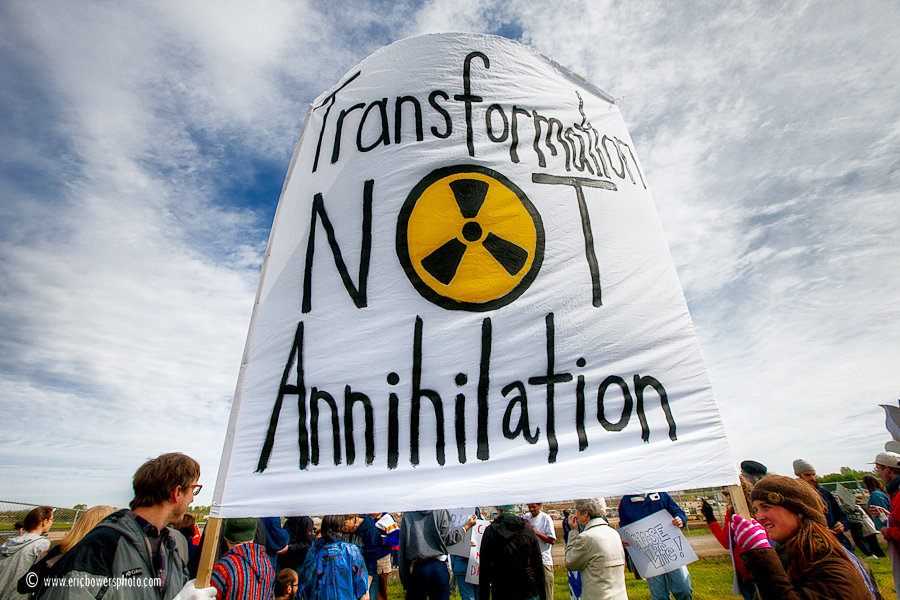
On Monday, May 2nd over 150 people gathered at the main entrance of the new nuclear weapons plant currently being built on 150 highway. The witness started with a street theater satirizing the "Religion of the Bomb," bringing to light the trust we place in this weapon of mass destruction for our security. In reality this is a form of civil religion and one of the idols of our time.
All were called to join in lamentation to recognize our common complicity:
We have all been part of darkness,
But we are light in the Lord.
Let us live our lives as Children of Light!
Light produces good fruit, the fruit of goodness, justice and truth.
So come out of the darkness, and expose it to the light.
Wake up sleeper, Rise from death,
and the Lord will Shine on you.
Ephesians 5:8-14
From there we transitioned into an ecumenical worship and sharing that lifted up the hope of Resurrection Living. One of the statements read, entitled "Transformation, Not Annihilation,” stated:
"The spirit of Easter has brought us together in hope--hope for life over death. We are here to call for the conversion of this plant from an instrument of war to an instrument of life... We lament this, the first new nuclear weapons production plant in 32 years, which will continue to make 85% of the non nuclear parts for nuclear weapons. We lament that over $815 million of Kansas City municipal bonds—which should be spent on social uplift--is being spent on building this plant. We lament the health risks posed by this plant to its workers and the people and environment of Kansas City. We have hope for the conversion of this plant--we imagine a rebirth where this site would provide beneficial, peaceful and green jobs, such as solar and wind energy jobs.”
After breaking bread, the crowd moved toward the gates of the complex. Some felt let by their conscience to continue "Gospel Obedience" by refusing to leave the road. In all 53 people were arrested and charged with criminal trespass, a city ordinance. Contrary to what was reported in the KC Star newspaper, the majority of people arrested were local, 32 from the home state of Missouri and 17 of those from KC.
15 min - Video of entire action
http://www.youtube.com/watch?v=T-s329ZW97k
Photos:
http://blog.ericbowersphoto.com/2011/05/nuclear-bomb-parts-plant-protest-monday/
https://picasaweb.google.com/lh/sredir?uname=joshua.mac&target=ALBUM&id=5602167213622481377&authkey=Gv1sRgCIXnpK2J0tbWcA&feat=email
Cherith Brook Catholic Worker, along with our sister community, Holy Family House Catholic Worker, co-hosted the event. Our theme was, "The Hope of Easter and a Disarmed World." The event began over the weekend and was an inspiring time of worship, clarification of thought and discernment, framed by morning and evening prayers.
At the height of activity over 150 people were present. Though most were from the greater Kansas City area, 20 different Catholic worker communities across the Midwest were also represented.
Art Laffin from the Dorothy Day CW in Washington, DC set the tone for the retreat with his talk that included an inspiring reflection on the Resurrection and Gospel nonviolence, comments on current nuclear policy, and the human and environmental cost of militarism, war and nuclear weapons. It concluded by calling all of us to engage in nonviolent resistance to the Nuclear Empire we live in and to hope for a disarmed world. (see the link for the text to Art's speech)
http://groups.google.com/group/National-CW-E-mail-List/browse_thread/thread/ac9b863e3b529715
On Sunday morning, a contingent of 20 retreat-ants held a prayer service at the entrance of the site next to the bill board that read, "Future home of NNSA - National Nuclear Security Administration Campus." Upon our return, we had an ecumenical worship service including Scripture reading, personal responses and Eucharist.
One of the Scriptural themes for the retreat comes from Acts 5:29, when the local powers try to silence the apostles for proclaiming the hope and truth of the resurrection. Peter responds by saying, "We must obey God rather than human authority.” We all consider the power of the resurrection to lay a greater claim on our lives than the false sense of security and idolatry of nuclear weapons.
It is noteworthy that among those arrested include strong representation from the host communities: Rachael Hoffman, Mark Bartholomew, Gina Cook, Robyn Haas, Br. Louis Rodemann, Sr. Theresa Maly, Sr. Mary Cecile Breen of Holy Family House and their extended community.
And Josh Armfield, Eric Garbison, Jodi Garbison, Nick Pickrell, Micah Waters, Elisabeth Rutschman, Sharon Hannah, and Christian Soulliere of Cherith Brook and our extended community.
We encourage each of you to discern ways to become more involved as people of faith in this local effort. How can you help?
- Financial gifts are needed to help defray the cost of our legal fees.
- Become more informed about the issue and then share what you’ve learned with your neighbor.
- Challenge your religious leaders to get involved, become familiar with your church’s teaching on nuclear weapons and bring it before your faith community.
- Get involved in KC Peace Planters, the local grassroots coalition, http://www.peaceworkskc.org/kcplant
- If you’re a KCMO registered voter, participate in the vote on November 8 that will prohibit the production of nuclear weapons components at the new plant.
- And pray, pray, pray…"for the prayers of the faithful availeth much."
Cherith Brook Catholic Worker
National Catholic Reporter news report:
http://ncronline.org/news/peace/over-50-arrested-protesting-nuclear-weapons-plant
Wednesday, May 11, 2011
Second Saturday Workday & Haircuts
Hello Friends,
This Saturday, May 14th, we will be having our usual second Saturday Work day at Cherith Brook. We will begin at 9 and finish with lunch at noon. Please let us know if you are going to be able to make so we can plan ahead for work projects. This Saturday we will be doing the following:
A lot of Work in the Garden
Tuck pointing
Painting
Sorting of clothing
Spreading mulch
and other fun things you will just have to come to experience!
We look foward to seeing you all this weekend!
Saturday, April 23, 2011
The Hope of Easter and A Disarmed World
FAITH & RESISTANCE RETREAT
We are calling for people of faith to practice Gospel Obedience and to resist the construction of a new Nuclear Weapons Plant at 150 Hwy and Botts Rd in south Kansas City. On the weekend of April 29-May 2, Holy Family House and Cherith Brook Catholic Workers will be hosting the Midwest Catholic Worker Faith and Resistance Retreat here in Kansas City. Catholic Workers from all over the Midwest will be coming together to put our faith into action by resisting Nuclear Weapons. Along with those coming from out of town, we greatly need participation from local Kansas City residents. The weekend will consist of a focus speaker, roundtable discussions, opportunities for spiritual reflection and prayer, Nonviolence training, and we will conclude the weekend with a nonviolent action on Monday May 2nd.
An urgent need has grown in Kansas City to resist the production of Nuclear Weapons. The Kansas City government has subsidized a new federal Nuclear Weapons Production Plant with $815 million in municipal bonds, over and above the National Nuclear Security Association’s (NNSA) annual budget. The new Plant’s selected 180-acre site at 150 Hwy and Botts Road was mostly used for soybean farming. However, the Kansas City government declared that area “blighted” so that it could use bond authority under Missouri state law designed to fight urban blight to give NNSA a new bomb plant. Taxpayers will pay an estimated $4.5 billion over 20 years for the new Kansas City Plant, which the City will own until private developers pay the bonds back through a lease-to-purchase scheme backed up by a virtually certain revenue stream from the federal government. This new Plant will replace an old Nuclear Weapons Plant, also in Kansas City; which has significant environmental and worker health concerns. We want to ensure that these matters are handled promptly and comprehensively.
We are deeply saddened by this act of planned violent destruction of human life, the misuse of funds intended for our blighted neighborhoods in which we live, the disregard for the health of workers and the pollution of our streams, fields, and air. We need your help to stop the future production of parts for nuclear weapons. We need you to pray with us, act with us, and be with us the weekend of April 29-May 2, 2011.
We encourage you to discern and pray about how God might be calling you to participate in these events. Here are some options:
1) You may come to the scheduled round-tables and listen to the speaker,
2) You may participate in the nonviolent action on Monday morning,
3) You may also choose to practice gospel obedience by risking arrest at the action, and
4) we hope that you are able to participate in all three of these. If you choose to risk arrest on Monday, we request that you at least participate in the nonviolence training that we are offering on Sunday afternoon. A schedule of the weekend is below.
---
The Midwest Catholic Worker Faith & Resistance Retreat:
The Hope of Easter and a Disarmed World
April 29—May 2, 2011
@ De La Salle Education Center
3740 Forest Avenue, Kansas City, MO 64109

Please consider:
Civil disobedience
Talk to your community, family & work place about committing civil disobedience with us on May 2, 2011
Coming early to create Art, Puppets & props
Come to Kansas City the week of April 22 to help us with preparations. We especially need artists and experienced builders. 10 people are welcome to stay at Cherith Brook and Holy Family House. Please call if interested!
Your Hosts:
Cherith Brook Catholic Worker
816.241.8047 cherithbrookkcmo@gmail.com
Holy Family House Catholic Worker
816.753.2677 holyfamilycw@gmail.com
If you need special sleeping arrangements, please let us know in advance!
We are calling for people of faith to practice Gospel Obedience and to resist the construction of a new Nuclear Weapons Plant at 150 Hwy and Botts Rd in south Kansas City. On the weekend of April 29-May 2, Holy Family House and Cherith Brook Catholic Workers will be hosting the Midwest Catholic Worker Faith and Resistance Retreat here in Kansas City. Catholic Workers from all over the Midwest will be coming together to put our faith into action by resisting Nuclear Weapons. Along with those coming from out of town, we greatly need participation from local Kansas City residents. The weekend will consist of a focus speaker, roundtable discussions, opportunities for spiritual reflection and prayer, Nonviolence training, and we will conclude the weekend with a nonviolent action on Monday May 2nd.
An urgent need has grown in Kansas City to resist the production of Nuclear Weapons. The Kansas City government has subsidized a new federal Nuclear Weapons Production Plant with $815 million in municipal bonds, over and above the National Nuclear Security Association’s (NNSA) annual budget. The new Plant’s selected 180-acre site at 150 Hwy and Botts Road was mostly used for soybean farming. However, the Kansas City government declared that area “blighted” so that it could use bond authority under Missouri state law designed to fight urban blight to give NNSA a new bomb plant. Taxpayers will pay an estimated $4.5 billion over 20 years for the new Kansas City Plant, which the City will own until private developers pay the bonds back through a lease-to-purchase scheme backed up by a virtually certain revenue stream from the federal government. This new Plant will replace an old Nuclear Weapons Plant, also in Kansas City; which has significant environmental and worker health concerns. We want to ensure that these matters are handled promptly and comprehensively.
We are deeply saddened by this act of planned violent destruction of human life, the misuse of funds intended for our blighted neighborhoods in which we live, the disregard for the health of workers and the pollution of our streams, fields, and air. We need your help to stop the future production of parts for nuclear weapons. We need you to pray with us, act with us, and be with us the weekend of April 29-May 2, 2011.
We encourage you to discern and pray about how God might be calling you to participate in these events. Here are some options:
1) You may come to the scheduled round-tables and listen to the speaker,
2) You may participate in the nonviolent action on Monday morning,
3) You may also choose to practice gospel obedience by risking arrest at the action, and
4) we hope that you are able to participate in all three of these. If you choose to risk arrest on Monday, we request that you at least participate in the nonviolence training that we are offering on Sunday afternoon. A schedule of the weekend is below.
---
The Midwest Catholic Worker Faith & Resistance Retreat:
The Hope of Easter and a Disarmed World
April 29—May 2, 2011
@ De La Salle Education Center
3740 Forest Avenue, Kansas City, MO 64109

Please consider:
Civil disobedience
Talk to your community, family & work place about committing civil disobedience with us on May 2, 2011
Coming early to create Art, Puppets & props
Come to Kansas City the week of April 22 to help us with preparations. We especially need artists and experienced builders. 10 people are welcome to stay at Cherith Brook and Holy Family House. Please call if interested!
Your Hosts:
Cherith Brook Catholic Worker
816.241.8047 cherithbrookkcmo@gmail.com
Holy Family House Catholic Worker
816.753.2677 holyfamilycw@gmail.com
If you need special sleeping arrangements, please let us know in advance!
Monday, April 4, 2011
Cherith Brook Easter 2011 Newspaper
Our Easter 2011 newspaper is now online. Be sure to read it and let us know what you think.
Easter 2011
Also, below is an article from that paper.
Word on the Streets
We began our work on foot. In hopes of giving airtime to street voices, we walked “The Avenue” (Independence Ave) and we hung out behind Dairy Queen. Later we frequented the “Alley House,” “Indian Hill,” “The Haunted House” and “The Wall.” We hiked into campsites behind Super Flea and the I-29 ramp off The Paseo Ave. We slid gingerly through broken windows and muddied our knees crawling under fences. We had coffee at Hope Faith, ate lunch at “Sally’s” (Salvation Army), and dinner at “Monday Night Church” (Micah Ministries).
We had our own ideas, of course. And we brought with us rich past experiences from prior work in Atlanta and Davenport. But we wanted street voices to speak into our calling. It is essential for anyone to speak to their own needs and wants. So, when people began to ask us if they could come to the house to do a load of laundry or take a shower, they helped create “The Shower House” (Cherith Brook).

We still take our weekly pilgrimage but with a different mandate. For one thing, we move around a lot less. In fact, we usually make a beeline to Fast Stop or Bronceados on the Avenue—both places are notorious for high drug sales and prostitution. And we no longer take food or toiletries. Aside from our prayers, we go empty handed.
So why the change? Our experiences over the past few years called to us for a new approach, in fact they screamed bloody murder. One afternoon we dragged a bleeding man into our living room from a drive-by shooting. Enrique was shot and killed in our alley after chasing armed robbers from his Aborrotes. Keith came over with bruises on his face and ribs after young men jumped him for the meager change earned panhandling. I visited Wes at Truman Medical Center after he suffered a shotgun blast to his ankle due to a “misunderstanding.” The Bigger Jigger bar down the street has had two fatal bar brawls in the past year. Recently, Yuri Ives, a real estate agent and a respected neighborhood leader, was shot in his own home with his own gun by a 17 year old intruder.
Then there is the amount of violence concentrated toward women, mirroring the way our culture persecutes women, consuming them for sexual satisfaction and as release for rage. Once I met a young lady on the streets who had her earlobe bitten off and her kneecap broken by the swing of a hammer held by her “date.” Last summer a friend showed up bleeding after being attacked by a serial rapist who was targeting prostitutes in the area. He had bitten her and stabbed her with a screwdriver before she fought him off.
These troubling experiences on the streets and stories at showers continue to collide with our understanding of Jesus and his gospel of peace. Though taunted by a culture of death, is our community not also a Christ haunted landscape? Is Jesus not already here in some form and if so where do we encounter him? When we don’t, how can we extend his presence by our own? How will we be received if we have nothing to offer but ourselves? Can our willingness to be there open up new possibilities or will it escalate the conflict? How can such spaces be redeemed for God’s conspiracy of goodness in a broken world?
Yes, we proclaim and witness to the fact that Jesus is there, exorcising the darkness and rescuing all things for God. Yes, we are a people of hope. As Colossians 1:20 says, “Through Christ God was pleased to reconcile to himself all things, whether on earth or in heaven, by making peace through the blood of his cross.”
Christians speaking about peace often give way to a two-fold temptation: On the one hand, we avoid affirming the transformative power of the gospel. Do we believe that we have weapons of the Spirit at our disposal? Do we believe that our commitment to peace is backed by a force even more powerful than the violence we face? If we proclaim that resurrection overcomes death, do we believe that includes the streets also?
One day while on our peace-walk, a man we didn’t know approached us talking excitedly. I remember his body gestures were strong. He spoke quickly but his words were tangled. We strained to make sense of what he was saying. We asked questions to get clarity, but it soon became clear that he was either strung out or crazy or both.
At some point I got a creeping feeling. His gestures were becoming forceful. His eyes became as wide as they were red. Was he angry or only getting animated? Whatever it was, my discomfort was rising. He called himself Gabriel but I was convinced he was no angel. When his hand went into his pocket I became cold. I suddenly realized we were alone; the other men had vanished. I almost stumbled backward. I remember trying to figure out how to get the attention of the others without worsening the situation. When he ripped his hand out of his pocket, my fear was realized. He had a knife. But then he did something I did not expect. Without pause, he turned and threw the knife across the street. We stood there frozen as we watched it skip across the concrete.
For weeks we tried to process this experience. At first we second-guessed ourselves. Had we created this problem, instigated something or pissed someone off? Was our approach too confrontational? Then our processing turned to panic: What are we doing? Who do we think we are anyway? I’m scared! We should just forget it.
Evaluation is essential. And all of these responses were natural. We have no death wish and we’re not going to throw caution to the wind. And yet, over time we became aware that we were so focused on our fear we had ignored the outcome—Gabriel threw away his knife! We were fixated on the causes for the danger and not what caused Gabriel to disarm.
I have learned to retell that story now in its entirety. I believe it was a miracle of nonviolence. That is to say, an event that points to Jesus’ victory over death. It exposes the chimera of violence and calls us to greater trust in the truth of Christ’s peace. I have no other way to make sense of it. And as I think back over the past four years, there are a dozen such occurrences.
Do we recognize the weapons of the Spirit at our disposal? Do we believe that our commitment to facing danger without harming others is backed by a force more powerful than evils surrounding us? Do we affirm the Resurrection we profess is stronger than the death we face? It is a great temptation not to. We have been disciplined by a belief in the need for force that overshadows the possibilities present in this age of resurrection.
This story highlights the other temptation. We are enticed to think God would not call us into work that might involve risk or even harm. Ron Sider once wrote of practicing Christian nonviolence, “Making peace is as costly as waging war. Unless we are prepared to pay the cost of peacemaking, we have no right to claim the label or preach the message.” Will we only affirm ministry that can guarantee our safety and security? Do we support those called to this kind of work or write them off as naïve or foolish?
We are well aware that there are no assurances that that things will always end up in our favor or that we will not be harmed. Glamorizing nonviolent living is no more truthful than glamorizing war. In all honesty, this work has exposed our own willingness to give into these temptations as well as our own fears, our own brokenness, even the violence within. We want to take seriously that as followers of Jesus we are set apart - made holy for the ways of peace - even if our vessels are humble, broken and vulnerable.
The sign and source of peace in the Colossians passage quoted above is the cross. It is, ironically, a symbol of violence. But it does not symbolize our means of power nor a weapon we might use against an enemy. In fact, in I Corinthians 1 & 2 Paul admits that others will see this symbol as a stupid or an irrational choice. They will see it as an indication that we are weak or passive. But we believe it was meant to symbolize that the power of peace is not an issue of might, force or coercion--all forms of human strength to which we often turn.
The cross is a revelation of the way God’s power plays out in the world. It was intended to jog our memory. It was Jesus’ humility, patience, willingness to endure suffering, and refusal to do harm that won the day. A contradiction to some and an insult to others, it is, nevertheless, to be our means, our strength and our comfort. “For to this you have been called, because Christ also suffered for you, leaving you an example, so that you should follow in his steps. ‘He committed no sin, and no deceit was found in his mouth.’ When he was abused, he did not return abuse; when he suffered, he did not threaten; but he entrusted himself to the one who judges justly” (I Peter 21-23).
Easter 2011
Also, below is an article from that paper.
Word on the Streets
We began our work on foot. In hopes of giving airtime to street voices, we walked “The Avenue” (Independence Ave) and we hung out behind Dairy Queen. Later we frequented the “Alley House,” “Indian Hill,” “The Haunted House” and “The Wall.” We hiked into campsites behind Super Flea and the I-29 ramp off The Paseo Ave. We slid gingerly through broken windows and muddied our knees crawling under fences. We had coffee at Hope Faith, ate lunch at “Sally’s” (Salvation Army), and dinner at “Monday Night Church” (Micah Ministries).
We had our own ideas, of course. And we brought with us rich past experiences from prior work in Atlanta and Davenport. But we wanted street voices to speak into our calling. It is essential for anyone to speak to their own needs and wants. So, when people began to ask us if they could come to the house to do a load of laundry or take a shower, they helped create “The Shower House” (Cherith Brook).

We still take our weekly pilgrimage but with a different mandate. For one thing, we move around a lot less. In fact, we usually make a beeline to Fast Stop or Bronceados on the Avenue—both places are notorious for high drug sales and prostitution. And we no longer take food or toiletries. Aside from our prayers, we go empty handed.
So why the change? Our experiences over the past few years called to us for a new approach, in fact they screamed bloody murder. One afternoon we dragged a bleeding man into our living room from a drive-by shooting. Enrique was shot and killed in our alley after chasing armed robbers from his Aborrotes. Keith came over with bruises on his face and ribs after young men jumped him for the meager change earned panhandling. I visited Wes at Truman Medical Center after he suffered a shotgun blast to his ankle due to a “misunderstanding.” The Bigger Jigger bar down the street has had two fatal bar brawls in the past year. Recently, Yuri Ives, a real estate agent and a respected neighborhood leader, was shot in his own home with his own gun by a 17 year old intruder.
Then there is the amount of violence concentrated toward women, mirroring the way our culture persecutes women, consuming them for sexual satisfaction and as release for rage. Once I met a young lady on the streets who had her earlobe bitten off and her kneecap broken by the swing of a hammer held by her “date.” Last summer a friend showed up bleeding after being attacked by a serial rapist who was targeting prostitutes in the area. He had bitten her and stabbed her with a screwdriver before she fought him off.
These troubling experiences on the streets and stories at showers continue to collide with our understanding of Jesus and his gospel of peace. Though taunted by a culture of death, is our community not also a Christ haunted landscape? Is Jesus not already here in some form and if so where do we encounter him? When we don’t, how can we extend his presence by our own? How will we be received if we have nothing to offer but ourselves? Can our willingness to be there open up new possibilities or will it escalate the conflict? How can such spaces be redeemed for God’s conspiracy of goodness in a broken world?
Yes, we proclaim and witness to the fact that Jesus is there, exorcising the darkness and rescuing all things for God. Yes, we are a people of hope. As Colossians 1:20 says, “Through Christ God was pleased to reconcile to himself all things, whether on earth or in heaven, by making peace through the blood of his cross.”
Christians speaking about peace often give way to a two-fold temptation: On the one hand, we avoid affirming the transformative power of the gospel. Do we believe that we have weapons of the Spirit at our disposal? Do we believe that our commitment to peace is backed by a force even more powerful than the violence we face? If we proclaim that resurrection overcomes death, do we believe that includes the streets also?
One day while on our peace-walk, a man we didn’t know approached us talking excitedly. I remember his body gestures were strong. He spoke quickly but his words were tangled. We strained to make sense of what he was saying. We asked questions to get clarity, but it soon became clear that he was either strung out or crazy or both.
At some point I got a creeping feeling. His gestures were becoming forceful. His eyes became as wide as they were red. Was he angry or only getting animated? Whatever it was, my discomfort was rising. He called himself Gabriel but I was convinced he was no angel. When his hand went into his pocket I became cold. I suddenly realized we were alone; the other men had vanished. I almost stumbled backward. I remember trying to figure out how to get the attention of the others without worsening the situation. When he ripped his hand out of his pocket, my fear was realized. He had a knife. But then he did something I did not expect. Without pause, he turned and threw the knife across the street. We stood there frozen as we watched it skip across the concrete.
For weeks we tried to process this experience. At first we second-guessed ourselves. Had we created this problem, instigated something or pissed someone off? Was our approach too confrontational? Then our processing turned to panic: What are we doing? Who do we think we are anyway? I’m scared! We should just forget it.
Evaluation is essential. And all of these responses were natural. We have no death wish and we’re not going to throw caution to the wind. And yet, over time we became aware that we were so focused on our fear we had ignored the outcome—Gabriel threw away his knife! We were fixated on the causes for the danger and not what caused Gabriel to disarm.
I have learned to retell that story now in its entirety. I believe it was a miracle of nonviolence. That is to say, an event that points to Jesus’ victory over death. It exposes the chimera of violence and calls us to greater trust in the truth of Christ’s peace. I have no other way to make sense of it. And as I think back over the past four years, there are a dozen such occurrences.
Do we recognize the weapons of the Spirit at our disposal? Do we believe that our commitment to facing danger without harming others is backed by a force more powerful than evils surrounding us? Do we affirm the Resurrection we profess is stronger than the death we face? It is a great temptation not to. We have been disciplined by a belief in the need for force that overshadows the possibilities present in this age of resurrection.
This story highlights the other temptation. We are enticed to think God would not call us into work that might involve risk or even harm. Ron Sider once wrote of practicing Christian nonviolence, “Making peace is as costly as waging war. Unless we are prepared to pay the cost of peacemaking, we have no right to claim the label or preach the message.” Will we only affirm ministry that can guarantee our safety and security? Do we support those called to this kind of work or write them off as naïve or foolish?
We are well aware that there are no assurances that that things will always end up in our favor or that we will not be harmed. Glamorizing nonviolent living is no more truthful than glamorizing war. In all honesty, this work has exposed our own willingness to give into these temptations as well as our own fears, our own brokenness, even the violence within. We want to take seriously that as followers of Jesus we are set apart - made holy for the ways of peace - even if our vessels are humble, broken and vulnerable.
The sign and source of peace in the Colossians passage quoted above is the cross. It is, ironically, a symbol of violence. But it does not symbolize our means of power nor a weapon we might use against an enemy. In fact, in I Corinthians 1 & 2 Paul admits that others will see this symbol as a stupid or an irrational choice. They will see it as an indication that we are weak or passive. But we believe it was meant to symbolize that the power of peace is not an issue of might, force or coercion--all forms of human strength to which we often turn.
The cross is a revelation of the way God’s power plays out in the world. It was intended to jog our memory. It was Jesus’ humility, patience, willingness to endure suffering, and refusal to do harm that won the day. A contradiction to some and an insult to others, it is, nevertheless, to be our means, our strength and our comfort. “For to this you have been called, because Christ also suffered for you, leaving you an example, so that you should follow in his steps. ‘He committed no sin, and no deceit was found in his mouth.’ When he was abused, he did not return abuse; when he suffered, he did not threaten; but he entrusted himself to the one who judges justly” (I Peter 21-23).
Sunday, April 3, 2011
Second Saturday Workday & Discernment Meeting
Our second Saturday work day is quickly approaching so we wanted to remind you to put it on your calendars for next Saturday April 9th. We will start at 9, work until 12 and finish our time with lunch and a tour (if you want one). We will be working on the following projects:
Tuck Pointing
Garden
Stump Removal
Mulch Spreading
Mortar Work
Spring Cleaning
and few other things as well.
If you plan to come please RSVP via email or you can call and let us know how many are coming with you.
Also, for those discerning whether or not to risk arrest at the Faith and Resistance Retreat April 29-May 1, we will be meeting this Sunday April 3rd at 4 PM here at Cherith Brook to discuss where we are feeling called to do in response to the Nuclear Weapons Parts plant that is being built in KC. All are welcome to attend and hopefully we can all learn together. Again, please RSVP if you plan to come.
Thanks and Peace,
Subscribe to:
Posts (Atom)